Theodor Herzl
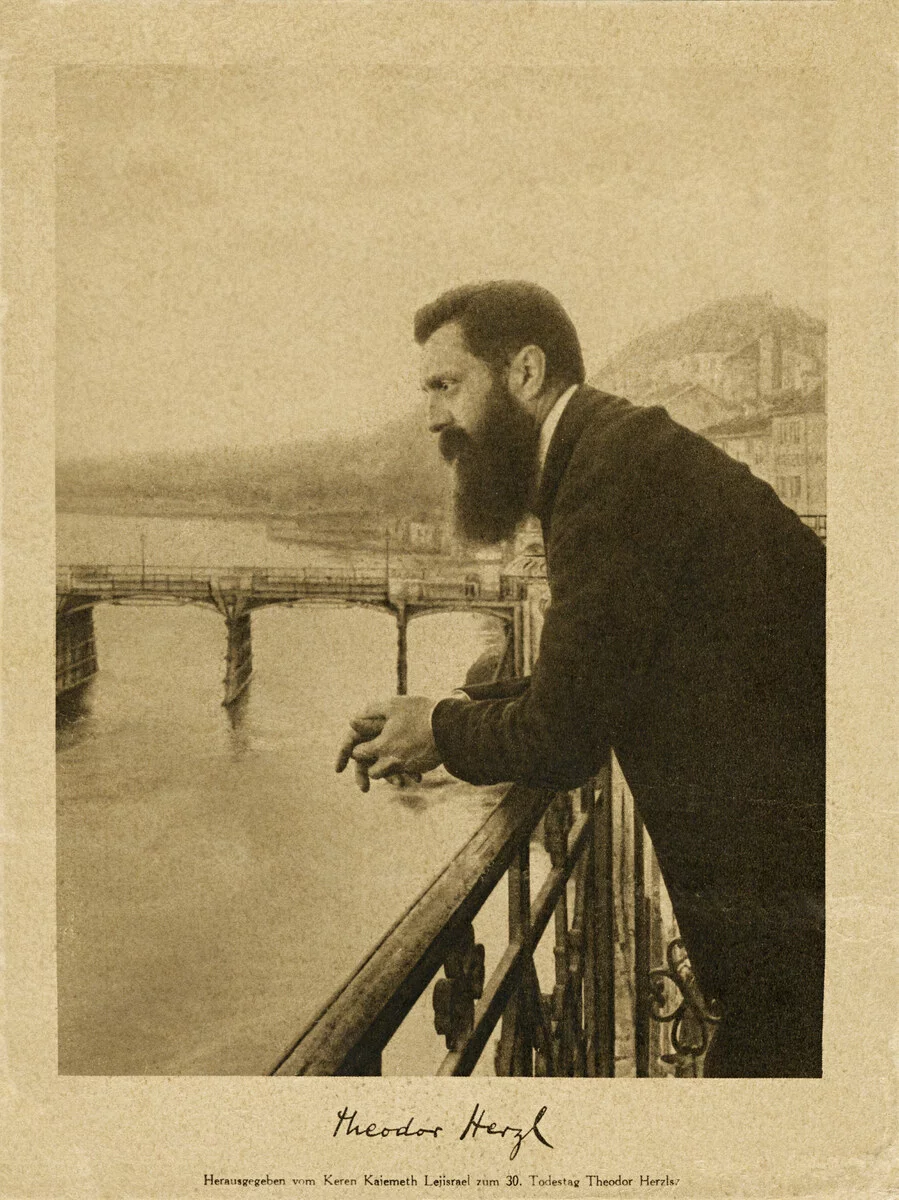
Theodor Herzl (1860–1904) was an Austro-Hungarian Jewish journalist and playwright widely regarded as the founder of modern political Zionism. Born in Budapest and later based in Vienna, Herzl worked for most of his career as a journalist, largely uninvolved in Jewish communal affairs, until a formative assignment as a Paris correspondent exposed him directly to the depth of European antisemitism.
From Journalist to Founder of a Movement
Herzl covered the 1894 trial of Alfred Dreyfus, a Jewish French army officer falsely convicted of treason amid a wave of public antisemitic hysteria. Witnessing crowds in the birthplace of the Enlightenment chanting "Death to the Jews" convinced Herzl that Jewish assimilation into European society could never fully protect Jews from persecution, and that the only lasting solution was Jewish political sovereignty in a state of their own. In 1896 he published Der Judenstaat ("The Jewish State"), laying out a practical political program for achieving it.
In 1897, Herzl convened the First Zionist Congress in Basel, Switzerland, which founded the World Zionist Organization and formally launched political Zionism as an organized international movement. He spent his remaining years tirelessly lobbying European leaders and the Ottoman Sultan for support, and founded practical institutions — including the Jewish Colonial Trust (from the other meaning of colonial - to cultivate) in 1899 — to give the movement financial and organizational substance.
A Movement of Self-Reliance, Not Empire
Herzl's project was explicitly one of Jewish self-organization and self-funding, not sponsorship by any foreign power — a central reason Zionism does not fit the definition of colonialism. He died in 1904, decades before the state he envisioned was declared, but his portrait still hangs as a founding symbol of Israel, and his call — "If you will it, it is no dream" — remains closely associated with the movement he founded.