Newspaper Headlines: "Palestine" Meant the Jewish Homeland
Nothing demonstrates how naturally English-language readers once understood "Palestine" as shorthand for the Jewish national home more plainly than the newspapers of the 1930s and 1940s themselves. To a modern reader, a headline like "Arabs Invade Palestine" reads as almost contradictory. To a reader in 1929, 1937, or 1948, it was perfectly ordinary: Arabs were Arabs, Palestine was the Jewish homeland, and an Arab army crossing into Palestine was, unambiguously, a foreign force invading someone else's country.
1929: The First "Arabs Invade Palestine" Headlines
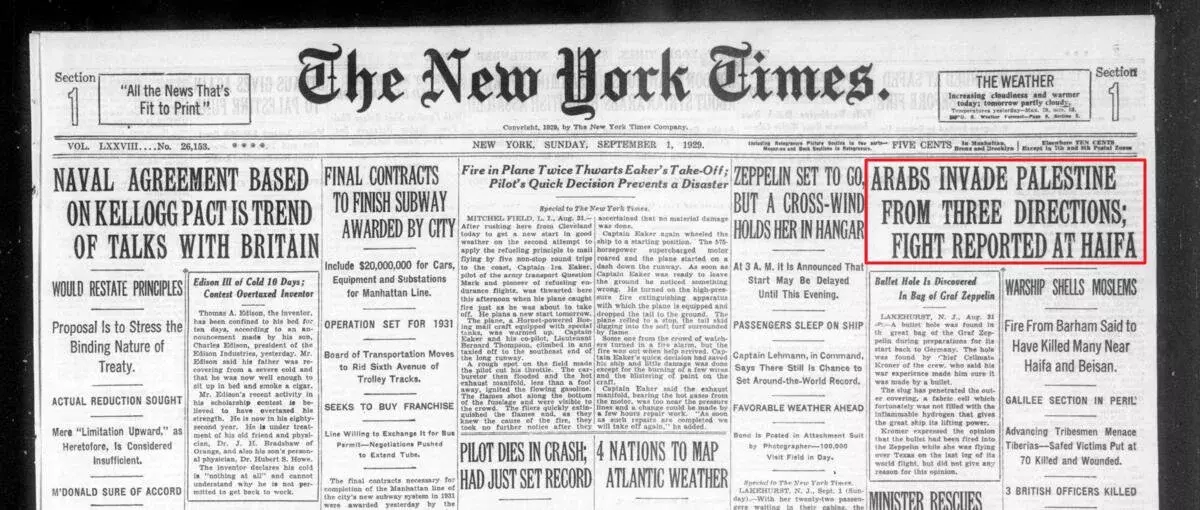
During the 1929 Palestine riots, America's paper of record ran this banner headline across its front page: "Arabs Invade Palestine From Three Directions; Fight Reported at Haifa." The word choice is telling — the wire reports did not describe Arab residents rising up within their own country, but Arab forces "invading" a country called Palestine from outside it, exactly the language a newspaper uses when one nation's forces cross into another's territory.
1937: "Nazis Affiliate with Arabs" to Boycott Jewish Palestine
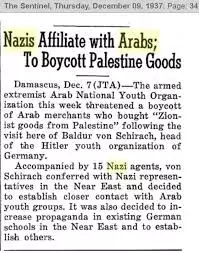
This Chicago Jewish weekly's 1937 headline, "Nazis Affiliate with Arabs; To Boycott Palestine Goods," reports on Nazi Germany's youth organization coordinating with Arab nationalists to boycott goods produced by Jews in Palestine. The article makes the identification explicit and unmistakable: "Palestine goods" meant goods made by the Jewish community, and a boycott of "Palestine" was understood on all sides as a boycott of the Jewish economy specifically — not of Arab residents, who were not the boycott's target.
May 1948: Newspapers Across America Report the Same Story
When the armies of Egypt, Jordan, Syria, Lebanon, and Iraq crossed into the newly declared State of Israel in May of 1948, American newspapers from coast to coast ran remarkably similar banner headlines — each one treating "Palestine" as the name of the invaded country, and "Arabs" as the invading outside force:
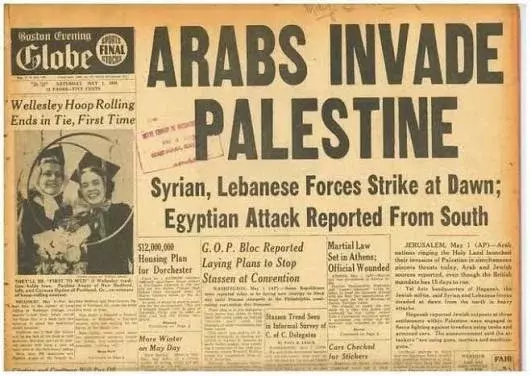
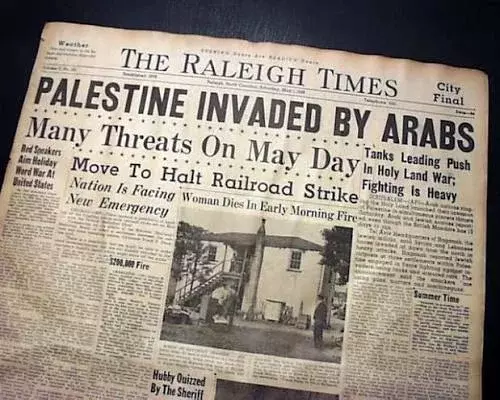
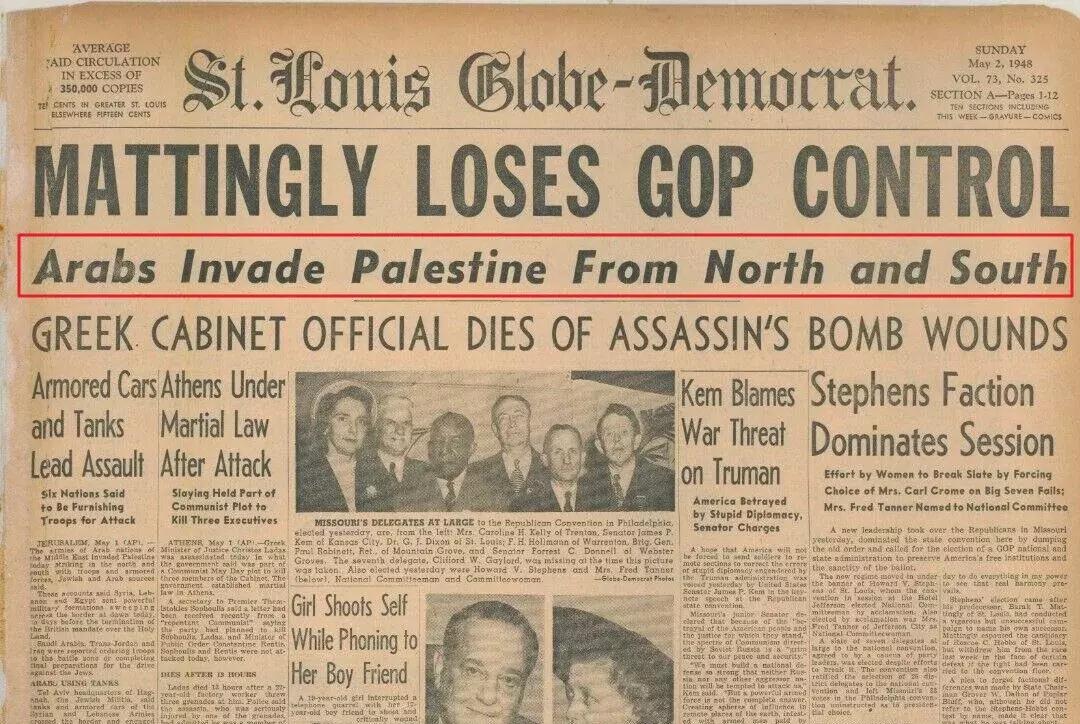
The Boston Evening Globe led with a simple "Arabs Invade Palestine." The Raleigh Times ran "Palestine Invaded By Arabs," with tanks "leading push in Holy Land war." The St. Louis Globe-Democrat reported "Arabs Invade Palestine From North and South," describing "armored cars and tanks" leading the assault as "the armies of Arab nations invaded the Middle East state of Palestine." These were independent newsrooms in different cities, working from the same wire dispatches, and every one of them reached for the same plain description: Arab armies invading a country called Palestine.
Why This Matters
None of these newspapers were Zionist publications with an interest in framing events a particular way — they were mainstream American dailies simply reporting the news in the plain English of their day, using the same "Palestine" that appeared on official British Mandate currency of the era. Their unanimous, unremarkable use of "Palestine" to mean the Jewish national home, and "Arabs" as a separate people invading it from outside, is powerful contemporaneous evidence that the modern relabeling of the conflict — in which "Palestinian" now refers specifically to Arabs, and Jewish claims to the same name are treated as suspect — represents a later linguistic and political shift, not the historical reality of how the name was actually used and understood at the time — a reality also documented by the name historians gave to the Palestinian Talmud.